
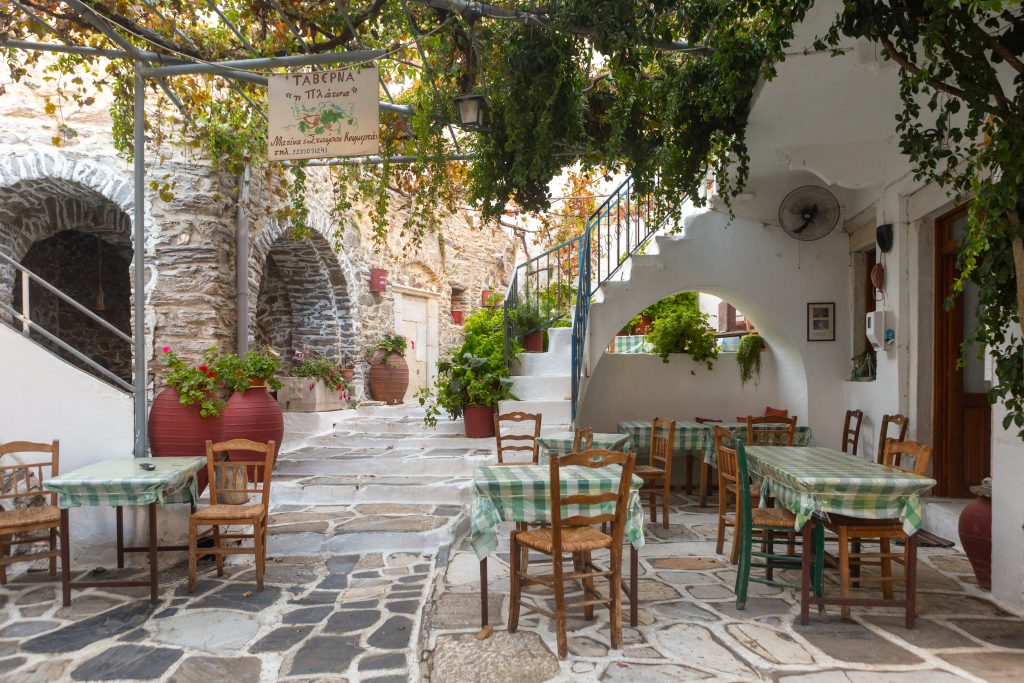
From Agios Prokopios beach, the lights of Naxos Town flicker about five kilometers northwest across a low fringe of olive groves and scrub. That distance , roughly a ten-minute drive, or a twenty-minute bus ride if the timing is right , is the single most useful fact for anyone arriving on this island for the first time. It tells you that the beach and the town are close enough to combine in a single day, but far enough apart that they feel like different places. That distinction, and the dozens like it that make up Naxos’s geography, is what this article exists to lay out.
Naxos covers 430 square kilometers, which makes it about three times the size of Paros and five times the size of Santorini. The distance from its northwest coast to its eastern shore is roughly an hour and a half by car on winding mountain roads, and the character of the island shifts significantly along the way. This is not an island you can accidentally see in an afternoon, and the choice of where to base yourself has real consequences for what your days look like. Understanding how Naxos is laid out before you look at hotel photos or compare beach names is what separates a well-planned trip from one that involves a lot of scrambling.
Think of Naxos in four zones: the northwest, where the ferry arrives and the old town sits; the west coast, which runs south from the town in a continuous strip of sandy beaches; the interior, a mountainous center of marble villages and fertile valleys; and the east coast, rugged and wind-exposed, that sees far fewer visitors. Each has its own character, its own transport reality, and its own reason for being worth your time.
Naxos Town (Chora): the island’s northwest anchor
Chora sits on the northwest tip of the island, facing the ferry lanes that connect Naxos to Piraeus, Santorini, and the other Cyclades. The town is built around its harbor, with a medieval Venetian kastro on the hill above and a working waterfront below. At the tip of the headland, the marble Portara , the enormous gate of an unfinished Temple of Apollo , stands where travelers have been arriving for two and a half thousand years.
This is where your ferry will dock and where most buses originate. The airport sits three to four kilometers southeast of the town center, closer to the west coast hotels than to Chora itself. That matters practically: if you arrive by plane, you are already on the beach side of the island.
Chora is a genuine working town, not a resort. The old quarter is a maze of narrow lanes climbing the hillside, lined with shops, tavernas, and small bars. The harbourfront is busier and less atmospheric, but it is where the ferries come and go and where the main bus terminus operates. The town has a nightlife scene , not on Mykonos’s scale, but real enough that the clubs along the waterfront can be heard from nearby hotels. Ferry noise is a genuine consideration for light sleepers staying close to the port.
Chora is worth choosing as a base if you plan to spend most of your time exploring cultural sites and interior villages, or if you value being at the center of the island’s logistics. The trade-off is clear: the beaches are five to ten kilometers away, and you will need the bus or a car every time you want to reach the sand.
The west coast: beaches, buses, and the sheltered side of the island
The west coast is where the beaches are, and there is a specific reason for that. The meltemi, the prevailing summer wind in the Aegean, comes from the north and northeast. The west coast sits in the lee of the island’s mountainous interior, sheltered from the wind. The east coast takes the full force of it. That one meteorological fact explains almost everything about where settlements grew, where roads were built, and where most travelers base themselves
The beaches run in a near-continuous strip south from Chora. Agios Prokopios is the first and most developed: a long arc of fine sand with famously clear water, backed by hotels, tavernas, and rental shops. It is a family beach, calm and well-served, with umbrellas and sunbeds in high season. About 1.5 kilometers further south, Agia Anna is slightly smaller and a little more relaxed, with a line of tavernas right on the sand. Another four kilometers on, Plaka opens into the longest uninterrupted beach on the island, nearly four kilometres of sand stretching all the way to Mikri Vigla at the southern end.
One practical detail that does not appear in most guides: a well-worn coastal path connects Agios Prokopios to Plaka, running behind the dunes for most of the way. The walk takes about 45 minutes at a steady pace and is the best way to see the entire beach strip without moving a car or waiting for a bus. Agios Prokopios to Agia Anna takes roughly 15 minutes on foot; Agia Anna to Plaka takes another half hour.
The bus situation on the west coast is straightforward. Buses run from Chora to Agios Prokopios every 30 minutes in high season, with the journey taking about 10 minutes, then continue south to Agia Anna and Plaka on the same route. This stretch of the island is genuinely viable without a car. You can stay on the west coast, reach Chora easily, and walk between beaches without needing to drive. The buses are not frequent enough that you plan your day around a timetable, but frequent enough that you simply walk to the stop and wait.
The interior: Tragea Valley, mountain villages, and Mount Zas
The centre of Naxos is unlike any other Cycladic island at this scale. A fertile inland plateau rises behind the coastal strip, covered in olive groves, citrus orchards, and vineyards. The Tragea Valley, the heart of this region, is where Naxos produced much of its wealth before tourism arrived. Scattered across it are Byzantine churches, some dating to the sixth century, half-hidden among the trees and barely signposted.
The mountain villages are what travellers mean when they say Naxos feels more substantial than the other islands. Apiranthos, about 13 kilometers east of Chora, is built entirely of marble: the streets, the archways, the doorsteps. It has a small archaeological museum and a folk museum that together take about an hour to see properly. The drive from Chora takes 30 to 40 minutes on winding roads that climb steadily through the hills.
Halki, roughly 20 kilometers south of Chora, is smaller and quieter, surrounded by citrus groves and approached through an arch of olive trees. A handful of cafes sit under the plane trees in the central square. Koronos, further east and higher up, is known for its pottery and for the fact that it sees almost no tourists at all.
Mount Zas, the highest peak in the Cyclades at 1,001 metres, rises in the center-east of the island. The main hiking route starts from the village of Filoti and takes four to five hours round trip, following a well-marked trail through scrub and rock to a summit with views across the entire island. A taxi from the west coast to Filoti costs roughly 30 euros one way.
Here is the honest truth about the interior that no one tells you directly. The buses to these villages are not adequate for independent exploration. There are four to six departures daily from Chora, timed for morning outings, with no service in the evenings. Take the bus to Apiranthos and you will have roughly three hours before the return option disappears. That is enough time for a walk through the village and a slow lunch, but not enough to combine with a stop in the Tragea Valley or a hike on Mount Zas.
The interior genuinely rewards having a scooter or a hire car. With your own transport, you can spend the morning at the beach and the afternoon in the hills, stopping at one of the Tragea Valley tavernas that serve lunch only, around midday, to a crowd that is almost entirely Greek. Without your own transport, the interior is still worth visiting: plan one village per day, accept that your bus schedule is fixed, and treat it as a reason to slow down rather than a constraint.
The east coast: rugged, quiet, and best understood for what it is not
The east coast is the part of Naxos that most first-time visitors will not see, and that is fine. The road network is narrower and less maintained. The beaches are pebbly or rocky, and the meltemi makes swimming uncomfortable on many days. Accommodation is sparse and basic.
What the east coast does offer, especially in July and August, is something the west coast cannot: genuine remoteness. Villages like Koronos and Stavros see a trickle of visitors. The coast itself, including beaches around the northeast corner near Panormos, is where you go if you want to be entirely alone on a stretch of shoreline with nothing but the wind and the sea.
For most first-timers, the east coast is best understood as the background of the island. It is the reason the interior villages feel protected, the reason the west coast beaches are as calm as they are. It is not a destination in itself for a beach-focused trip, but if you have a car and a free afternoon, a drive across the island to see the eastern coastline is worth doing once. Plan it as a detour rather than a day in its own right.
Choosing your base: what the geography means for your trip
The geography of Naxos narrows down to three practical trip profiles, and being honest about which one fits you makes the accommodation decision straightforward.
If your priority is the beaches, with Chora and the villages as day trips, base yourself on the west coast: Agios Prokopios, Agia Anna, or the northern end of Plaka. You can walk to the sand in minutes, reach Chora in ten by bus, and visit the interior on the day you arrange a scooter or hire car. This suits most first-time visitors.
If your priority is the cultural sites and the harbor atmosphere, and you are happy to commute to the beach, base yourself in Chora. The trade-off is that the best beaches are always a bus ride away, and the port environment is part of your immediate context. This suits travelers who plan to spend more time exploring than lying on sand.
If you want both equally, the west coast is still the better answer. A base in Agios Prokopios or its neighboring beaches puts you within a ten-minute bus ride of Chora and directly on the beach strip. You lose the harbour atmosphere of the town, but you gain five-minute access to the sand and fifteen-minute access to everything else.
To make this concrete: Lagos Mare sits 350 metres from Agios Prokopios beach, five kilometers from Chora, and two kilometers from the airport, with a bus stop within easy walking distance. It is a practical illustration of what a well-positioned west coast base looks like in real terms , close enough to the town and the island’s activity to make day trips easy, far enough from the port to make evenings genuinely quiet.
Quick-reference decision table
| Priority | Best base area | Transport needed |
| Beach access, families | Agios Prokopios or Agia Anna | None: bus covers Chora |
| Beach + easy village day trips | Agios Prokopios, Plaka north | Hire car or scooter for 2–3 days |
| Cultural sites, nightlife | Naxos Town (Chora) | Bus to beaches; car for interior |
| Exploring the interior | Chora or west coast, car essential | Hire car strongly recommended |
| Solitude, off-grid feel | East coast villages | Own transport required |
For anyone who finds this easier to absorb visually, an orientation map covering the same ground , drive times, bus routes, and the distinctions between zones , is available to download from the blog.
The natural next step for most people at this stage is a closer look at Agios Prokopios beach itself: what the sand and water are actually like, what is within walking distance, and what a day there looks like in practice.
Once you have a sense of the beach, the things to do in Naxos guide is where the island’s activities and itinerary possibilities come into focus , useful for working out whether Naxos can hold your interest for a full week, and how to structure the time.
FAQ
How big is Naxos?
Naxos covers 430 square kilometres, making it the largest of the Cyclades. It is roughly 42 kilometres from north to south and 34 kilometres across at its widest point. Driving from the northwest coast to the east coast takes about an hour and a half on winding roads. The island is large enough that where you base yourself has a direct effect on what your days look like.
How far is Agios Prokopios from Naxos Town?
About five kilometres, or a ten-minute drive. The bus runs every 30 minutes in high season and the journey takes around 15 minutes. A taxi costs roughly 10 to 15 euros. The two are close enough to combine comfortably in a single day.
Do I need a car in Naxos?
It depends where you plan to spend your time. The west coast beaches and Naxos Town are well served by public buses, and many visitors based on the west coast manage the entire trip without driving. The interior villages and the east coast are a different matter: buses to Apiranthos, Halki, and the Tragea Valley run only four to six times daily with no evening service. If you want to explore the interior independently, rent a scooter or hire car for at least two days of your trip.
What is the difference between Naxos Town and the beach areas?
Naxos Town is a working port and the island’s cultural hub, with a medieval old town, museums, shops, and nightlife. The beach areas , Agios Prokopios, Agia Anna, Plaka , are quieter strips centred on the sand, five to ten kilometres to the south. They serve different purposes in a Naxos trip, and they are connected by regular buses that make moving between them easy.
Are the inland villages of Naxos worth visiting?
Yes, for anyone interested in traditional Cycladic life, Byzantine history, or mountain landscapes. Apiranthos and Halki are among the most atmospheric places in the Cyclades. The practical caveat is that they require your own transport to explore freely. A good approach is to dedicate one day to a hire car or scooter, combine a village visit with lunch at a Tragea Valley taverna that serves midday only, and treat the interior as a counterpoint to the beach days rather than an afterthought.
What are the main areas of Naxos?
The island divides into four zones: the northwest coast around Naxos Town, where the port and main cultural sites are; the west coast from Agios Prokopios south to Mikri Vigla, which has all the main sandy beaches; the mountainous interior with the Tragea Valley, Apiranthos, Halki, and Mount Zas; and the east coast, rugged, sparsely populated, and visited mainly by those seeking solitude.