
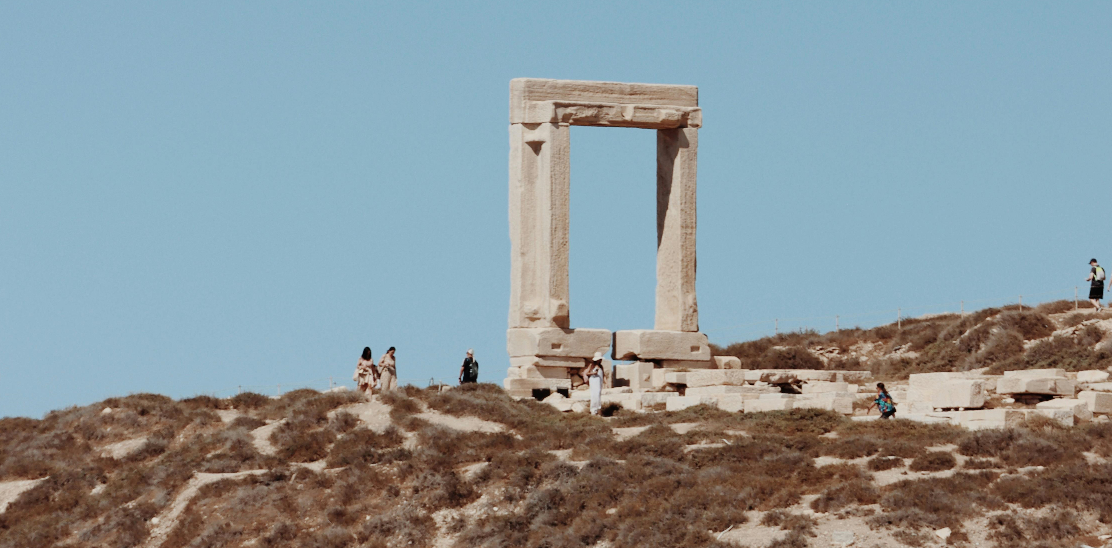
The lintel stones weigh over twenty tonnes each. When you stand beneath them at the Portara, that fact becomes something you feel in your shoulders. The stones were quarried from Naxian marble somewhere in the island’s interior, hauled down to the coast, ferried across the short channel to Palatia islet, and hoisted into position using rope, timber, and human intention. Then the hoisting stopped. The crane marks are still there.
This is not a medieval gate, not a freestanding arch, not a romantic ruin that time gradually wore down. It is the east entrance of what was planned as the largest Doric temple in the Archaic Greek world, abandoned around 500 BCE because the man who commissioned it was overthrown. The Portara survives not because it was completed, but because the stones were too heavy to remove.
What you are actually looking at
The gate stands 8.8 meters high and 4.3 meters wide. The lintel stones are local Naxian marble, transported to the coast by methods archaeologists still debate, then ferried to the islet of Palatia. The islet itself sits at the end of a 400-metre causeway that was submerged until the eighteenth century, when it was dredged for port access. What looks like a natural promenade is a relatively recent feature of the landscape.
The planned temple would have measured roughly 60 meters by 30 meters: comparable in scale to the Parthenon, which was built several decades later in Athens. This was not a modest commission. It was a statement of regional power by a ruler who controlled one of the wealthiest islands in the Archaic Aegean and intended a monument to match.
Only three columns were ever set. Of the east entrance, only the doorway itself was completed enough to remain standing. Everything else is foundation traces and broken stone.
What the Portara is, and why it was never finished
The commission belonged to Lygdamis, tyrant of Naxos, who ruled from roughly 530 to 520 BCE. In the Archaic Greek world, the word tyrant did not carry its modern implication of cruelty. It described someone who had taken power outside traditional aristocratic structures, often with popular support. Lygdamis used Naxos’s wealth and naval strength to make the island a significant regional force. He began a temple programme that would outdo anything the Cyclades had yet seen.
Construction continued for perhaps two decades. Then, around 500 BCE, Lygdamis was overthrown by a Spartan-backed coalition with its own interests in containing Naxian influence. The temple was not abandoned because the money ran out or because the marble proved unsuitable. It was abandoned because the political conditions that made the project possible ceased to exist.
The evidence for this is still visible in the stone.
How to read the stones
Stand at the base of the Portara and look up at the lintel. The scored lines and levering points are there on the surface. Archaeologists read these as the marks left by the hoisting operation, still present because the stones were being maneuvered into their final positions when the work stopped. Not at a natural pause. Mid-operation.
The east entrance columns show the same pattern. Set in place, but never fluted. The stone surfaces retain the rough dressing from the quarry rather than the finished polish that would have followed. You can see, standing in front of the gate, exactly how far the project reached and exactly where it stopped.
Fifty metres directly behind the gate, the Palatia excavations show the temple’s foundation stones laid out across the islet. This section of the site is free to enter and almost always quiet. Bus tours arrive at the causeway, photograph the gate, and turn back without walking the short distance that gives the entire structure its context. The footprint of the intended building becomes clear only from there.
Getting there
From the ferry terminal in Naxos Town, the Portara is a ten-to-fifteen-minute walk. Turn right along the waterfront path from the ferry landing. The distance is roughly 700 to 800 metres, flat, paved, and straightforward. If you are staying in Chora, no transport is needed.
From the Agios Prokopios area on the west coast, the drive is ten to fifteen minutes along a well-signed coastal road. [Internal link: a guide to Agios Prokopios beach would fit here , add URL once published] If you are without a car, the KTEL public bus runs hourly from the Agios Prokopios stop to Chora. The fare is €1.80 and the ride takes around fifteen minutes. Buses stop near the port, from which the causeway is the same short walk.
A car is genuinely useful if you are based on the west coast and want to combine the Portara with other stops in town. It is not necessary if you are based in Chora.
When to visit, and what to expect
The best light comes roughly one hour before sunset. In summer, that means arriving around 7:30 to 8:00 PM depending on the month. The gate frames the sun as it drops toward the Aegean, and the marble takes on the pink and gold that fills every photograph of the site.
In July and August, the causeway draws more than a hundred visitors per hour at sunset. Tour groups arrive in clusters. The tip of the causeway fills. If you want space to stand still and look rather than position yourself around other people, arrive 45 minutes before sunset and find a spot roughly 20 meters back from the gate itself. The view is unobstructed from there, and the crowd tends to cluster at the very end of the causeway.
In May, June, September, and October, you will share the site with fewer than twenty people per hour. The light is softer, the heat is manageable, and the Meltemi has not yet reached its peak. This is the easier time for anyone who wants to feel the site rather than navigate it.
That wind is worth knowing about. The Meltemi peaks in July and August. The causeway is fully exposed, and gusts can reach 40 kilometers per hour. It affects comfort, it affects photographs, and in strong conditions it affects the stability of a tripod. Check the forecast before a summer evening visit. Bring a layer even in August. The wind drops the perceived temperature significantly once the sun is low.
The site has no admission fee and is open around the clock throughout the year. There is also no artificial lighting. Some travel captions suggest the Portara is illuminated after dark. It is not. If you visit after sunset, bring your own light. The causeway walk back to Chora is unlit, and the cliffs around the islet drop ten meters into the sea on three sides with minimal guardrails. Stay on the paved path.
What else is nearby
The Palatia excavations, fifty meters behind the gate, take around twenty minutes to walk slowly through. They are free, shaded in parts, and consistently quieter than the gate itself. The foundation stones here give you the full footprint of what Lygdamis intended.
A five-minute walk from the causeway, the Archaeological Museum of Naxos holds finds from the Palatia site and surrounding area. It is open Tuesday through Sunday from 8:30 AM to 3:00 PM. Admission is €3. The collection is focused rather than comprehensive, and it gives the Portara proper context: what the temple was built to honor, and what Naxos looked like in the century that produced it.
Ten minutes from the causeway, the Venetian Kastro quarter rises above Chora. Medieval towers, marble lanes, a cathedral standing since the thirteenth century. The Kastro shows a different layer of the island’s history: the centuries when Naxos was a Venetian duchy, then an Ottoman territory, then Greek again. The architecture makes that layering visible.
These three sites together fill a half-day. Walk from the Portara to the excavations to the museum, then climb into the Kastro for the afternoon. End at a café in the old market before the light changes.
Fitting the Portara into your Naxos itinerary
The Portara rewards a traveler who engages with it as a historical site: someone who walks the fifty meters to the excavations, reads the tool marks, and understands what the incomplete fluting means. For that traveller, a half-day in Chora built around the gate, the museum, and the Kastro is genuinely well spent. [Internal link: a guide to things to do in Naxos would fit here , add URL once published]
For a traveler who arrives, photographs the gate, and leaves, the honest duration is fifteen minutes. There is no shame in it. The Portara is a single structure, not a complex. Some visitors feel satisfied in minutes, and that is a legitimate response to a remarkable object.
From the west coast, the Portara pairs naturally with an afternoon in Chora. Drive in after lunch, walk the causeway in the late afternoon, spend time at the excavations, eat dinner somewhere in town, and return to the gate as the sun goes down. That sequence turns a single landmark into a complete evening.
The Portara is one answer to the question that brought most visitors to Naxos in the first place. The island has genuine cultural substance beyond it: the ancient marble quarries in the mountains, the Byzantine churches hidden in the valleys, the medieval towers scattered across the interior. The gate is the most visible layer of a longer story.
If you are staying on the west coast, Lagos Mare sits 5 kilometers from Chora along the coastal road, with the Portara and the town’s cultural sites a straightforward drive in either direction. The hotel’s position between Agios Prokopios beach and Naxos Town is one of the practical things that makes that kind of day work. You can find the details at Lagos Mare.
The Portara is a beginning, not a summary. The marble quarries in the mountains, the Byzantine churches in the valleys, the village festivals most visitors never know are happening , there is more of Naxos to describe. Sign up below and I will send you the next piece when it is ready.
FAQ
What is the Portara in Naxos?
The Portara is the east entrance of an unfinished Archaic Greek temple dedicated to Apollo. It stands on the islet of Palatia, connected to Naxos Town by a 400-metre causeway, and dates to roughly 530 to 500 BCE. The gate is all that was completed before construction stopped.
Why was the Temple of Apollo never finished?
Construction halted around 500 BCE after Lygdamis, the tyrant who commissioned the temple, was overthrown by a Spartan-backed political coalition. The abandonment was sudden and political, not gradual. The tool marks on the lintel stones indicate the hoisting operation stopped mid-process.
How do you get to the Portara from Naxos Town?
Turn right from the ferry terminal and walk along the waterfront path. The causeway begins at the end of the promenade, roughly 700 to 800 meters from the terminal. The walk is flat, paved, and takes ten to fifteen minutes.
Is the Portara free to visit?
Yes. There is no admission fee and the site is open at all hours throughout the year. The adjacent Palatia excavations are also free to enter.
What is the best time to visit the Portara Naxos?
One hour before sunset in the shoulder seasons of May, June, September, and October offers the best combination of light, manageable wind, and low crowds. Summer sunsets draw well over a hundred visitors per hour; arrive 45 minutes early and position yourself back from the gate to find space.
Is the Portara lit up at night?
No. The site has no artificial lighting. Evening visitors after dark need their own light source. The causeway path is unlit and the cliffs around the islet are unguarded, so stay on the paved surface.