
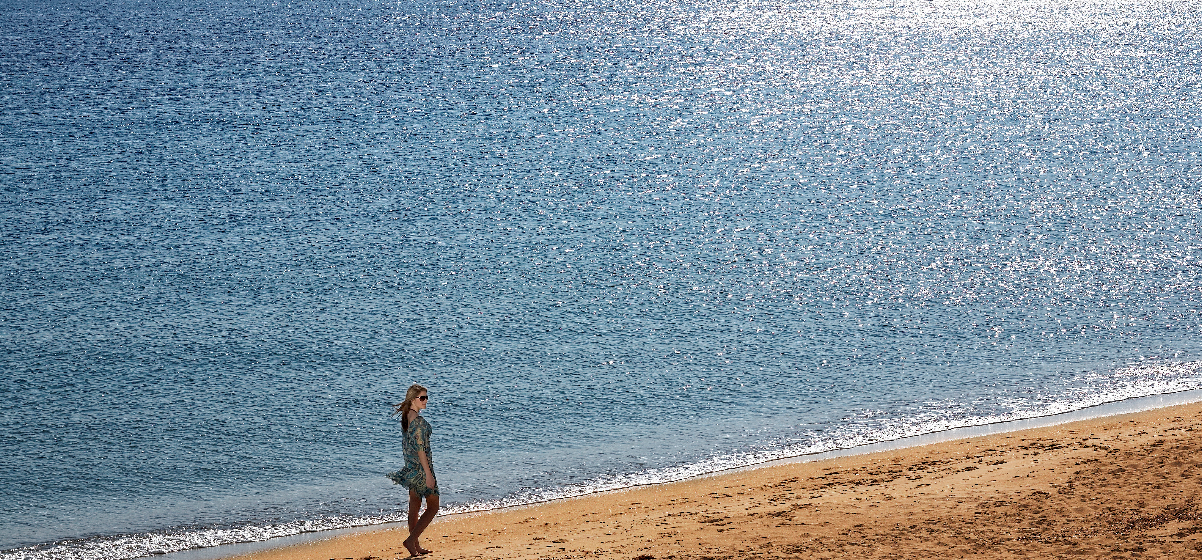
The afternoon thermal hits the south coast of Naxos around 2pm in July. You feel it first as a shift in the air, then as a steady push against your skin, and within thirty minutes the water that was calm at lunch has developed a chop that carries sand into suspension. On the west coast, the same afternoon passes differently. The wind arrives later, gentler, sometimes not at all. Agios Prokopios stays flat enough that you can float on your back without swallowing saltwater.
This difference , not a quality ranking, not a superlative about how beautiful the beaches are , is the single most useful thing to understand when choosing where to base yourself on Naxos.
The island has around forty named beaches, but the practical reality is simpler. The west coast runs south from Naxos town in an almost unbroken line of fine golden sand, sheltered from the Etesian winds that blow hard from the north during summer. The south coast faces the open sea and takes the full force of those winds. The north coast is mostly rock and pebble. The question is not which beach is best. The question is which beach matches how you actually want to spend your days.
What actually separates one Naxos beach from another
Three variables determine whether a beach will work for you, and they matter more than any photograph or TripAdvisor rating.
Wind exposure is the first. The Etesian winds, known locally as the meltemi, arrive reliably from mid-July through August, blowing from the north with enough force to make swimming uncomfortable and sunbathing genuinely unpleasant on exposed beaches. On the west coast, these winds are blocked by the island’s geography. On the south coast, they arrive unimpeded. This is not a marginal difference. It is the difference between a beach you can spend the whole day on and a beach you need to leave by early afternoon.
Infrastructure level is the second. Some beaches have sunbed rental, tavernas within walking distance, and parking within sight of the sand. Others require you to bring your own water, your own shade, and your own food. Neither is better, but which one suits you depends entirely on whether you want a day where the biggest decision is which taverna to walk to for lunch, or a day where you pack a bag and feel properly away from everything.
Seasonal timing is the third, and the one most beach guides get wrong. A beach in May is not the same beach in August. The water warms through June, peaks in August at around 26°C, and stays genuinely warm at 24 to 25°C through most of September. Crowds follow a similar curve but shift later: the busiest weeks are the first three of August, and by the second week of September the beaches are noticeably quieter. Wind patterns are less predictable at the edges of the season, which matters more for September visitors than most guides acknowledge.
Keep these three variables in mind. Everything else is detail.
The west coast, Agios Prokopios and Plaka
Most couples end up here, and for good reason.
Agios Prokopios is a 1.5 to 2-kilometre stretch of fine golden sand that faces southwest, protected from the meltemi by the curve of the coastline. The water is calm throughout the summer , calm enough to swim in the early morning before the sunbeds are set up, calm enough that families with small children feel comfortable, calm enough that you do not spend your day fighting the sea. The sand stays soft underfoot even in the midday heat, and the gradient is gentle enough that you can walk out twenty meters and still have the water at your waist.
The village behind the beach has the infrastructure you need: a handful of tavernas serving fresh seafood and Naxian produce, a bakery for morning pastries, a bus stop that runs into Naxos town every thirty minutes in peak season. Sunbed rental is available but not aggressive. You can claim a spot in the morning without negotiating, and by late afternoon the beach begins to thin out as day visitors head back to town.
To be honest about what Agios Prokopios is in August: it draws hotel guests and a steady flow of day visitors, but “busy” here means something different than on Santorini or Mykonos. You will not struggle to find space. You will not feel like you are queuing for the water. Arrive before 10am and you will have the stretch nearest the village largely to yourself for the first hour.
Plaka sits two kilometers south along the same coastline. The sand is the same quality and the water is equally calm, since it shares the same southwest exposure. What differs is density. Plaka is longer than Agios Prokopios and less developed, with fewer sunbeds, fewer tavernas, and a wider sense of space. If you want to walk for an hour along the water and feel like you have the beach to yourself, Plaka delivers that in a way Agios Prokopios does not in August.
But there is a trade-off. Plaka has less food infrastructure. You will need to walk further for lunch or bring something with you. The road access is good, but the parking areas are set back from the sand. And if you are staying without a car, getting here from your accommodation is a longer walk or a short taxi ride rather than a morning stroll.
How to match a beach to how you actually want to spend your days
This is the decision that matters more than any beach description, so here it is stated directly.
If you want to swim before breakfast, walk back to your hotel for a proper Greek breakfast, spend the morning reading on the sand, walk to a taverna at 1pm for lunch, rest through the hottest part of the afternoon, and then drive five kilometres into Naxos town for dinner at 8pm , Agios Prokopios is where that day happens. The combination of calm water, walk-able village infrastructure, and proximity to town makes it the only beach on the west coast that delivers this rhythm without compromise. You do not need to plan the logistics. They simply work.
If you want a longer beach day where you settle in for the full stretch from morning until late afternoon, and where the feeling of having space around you matters more than having a taverna within a three-minute walk, Plaka is your beach. You will need to bring lunch or accept a longer walk to find it, but the trade-off is real and worth making for the right traveller.
If you want genuine solitude and are willing to drive forty minutes and carry your own supplies , keep reading to the section on Alyko.
The south coast, Mikri Vigla and Alyko
Mikri Vigla appears on many Naxos beach lists with a description that implies it is simply another nice beach. This is misleading, and it is worth being straightforward about why.
Mikri Vigla faces south and catches the full force of the afternoon thermal. From late June through August, the wind picks up around midday and builds steadily through the afternoon. By 2pm, the water is choppy, the sand is blowing, and conditions that were pleasant at 10am have become actively uncomfortable for swimming and sunbathing. The beach is not calm. It is not a lounging beach in peak season.
What Mikri Vigla genuinely is, and what it deserves to be known for, is a reliable wind sports destination. Kite surfers and windsurfers come here specifically because the afternoon wind creates good conditions for the sport. If you are looking for that experience, Mikri Vigla is excellent. If you are looking for calm water and somewhere to read a novel on a towel, this is the wrong beach in summer.
Alyko is different. It sits further south, backed by a cedar forest that provides some shelter, and it has a wild, almost untouched feel that is increasingly rare on the island. The water is clear, the sand is good, and the forested backdrop gives the beach a character that the open west coast stretches lack. But Alyko has zero infrastructure: no sunbed rental, no taverna, no shade except what you bring, no fresh water. You need a car to reach it. You need to carry everything you will need for the day.
It is beautiful for a half-day excursion , arrive early, swim, explore the forest, leave by early afternoon , but it is not a base beach. You would not want to stay nearby because there is nothing nearby to stay in.
Agios Georgios, convenient, popular, and honestly not the reason most couples come to Naxos
Agios Georgios is the closest beach to Naxos town. You can walk from the center of Chora in ten minutes. The sand is wide, the water is calm, and in the mornings it is genuinely pleasant. Locals swim here before work, parents bring small children because the entry is shallow, and the proximity to town means you can combine a beach morning with a market visit or a wander through the old town.
But Agios Georgios also draws the most day traffic. In July and August it fills quickly, with sunbeds packed more tightly than at Agios Prokopios or Plaka, water that can feel busy with swimmers and inflatables, and a beachfront that has the feel of resort infrastructure rather than somewhere you happened upon. Tavernas with English menus, souvenir shops, the kind of convenience that makes a beach an amenity rather than a destination.
It is fine. It is not remarkable. If you are staying in Naxos town and want a quick morning swim, it serves that purpose well. But if the beach is a primary reason you chose Naxos, Agios Georgios is not why you came. You came for the long golden stretches further south.
A quick-reference table: matching beach to traveller
| Beach | Water in peak season | Infrastructure | Best for | Avoid if |
| Agios Prokopios | Calm, sheltered | Tavernas, sunbeds, bus stop | Couples wanting daily rhythm, easy access to town | You want long stretches with few people nearby |
| Plaka | Calm, sheltered | Minimal: few tavernas, sunbeds sparse | Space-seekers, half-day explorers | You do not have a car, or want lunch without walking |
| Mikri Vigla | Choppy by early afternoon | Surf schools, some facilities | Kite surfers, windsurfers | You want calm water for swimming after midday |
| Alyko | Variable, south-facing | None | Solitude, half-day excursion with a car | You are not self-sufficient for the day |
| Agios Georgios | Calm | Extensive: town-adjacent, all facilities | A quick swim combined with a town morning | You want a proper beach day without resort density |
Seasonal variation , the detail most beach guides skip
May to early June. Water temperature 21 to 23°C. Cool but comfortable for swimming, especially by afternoon. Minimal crowds everywhere. Light winds are predictable. This is the best window for experiencing all of Naxos’s beaches at their most pleasant. You can swim at Mikri Vigla without wind issues. You can have Plaka nearly to yourself. If you are planning a trip for this period, you can choose your beach based on character rather than wind protection.
July to August. Water temperature 25 to 27°C: warm and comfortable. The Etesian winds arrive in force from mid-July. On the south coast, swimming becomes unpleasant by early afternoon most days. On the west coast, conditions remain good throughout. Crowds peak in the first three weeks of August. Morning sessions before 11am are the best strategy everywhere.
September. Water temperature 24 to 26°C, often warmer than June. Crowds thin significantly after the first week. This sounds ideal, and for many travelers it is , but here is the caveat: wind variability increases. Some September days are perfect, calm, warm, quiet. Other days bring the meltemi late in the season, and on those days even the west coast can develop a chop. If you have a car and can move between beaches based on conditions, September is excellent. If you are fixed in one location, choose that location carefully.
October. Water temperature 20 to 22°C. Cool but still swimmable, particularly in the afternoon. Beaches are largely deserted. Weather becomes more unpredictable: some days are warm enough for a full beach day, others are overcast and cool. This is for the determined beach-goer, not the casual traveler.
Which beach, and where to base yourself
If your priority as a couple is reliable swimming in calm water, access to a taverna for lunch without getting back in the car, and an easy evening drive into Naxos town for dinner and drinks, the decision is straightforward: base yourself on the west coast, at Agios Prokopios.
The beach delivers the conditions. The village delivers the daytime food and amenities. The five-kilometre drive into town delivers the evening. And a hotel within a few hundred meters of the sand delivers the crucial advantage: you can walk to the water while the beach is still quiet, return for breakfast without the sand having cooled, and leave yourself free to go out or stay in as the mood takes you.
Lagos Mare sits 350 meters from Agios Prokopios , close enough to walk down before breakfast, far enough to feel like a place with its own life. The 1924 Restaurant serves breakfast each morning and dinner each evening, using seafood from the family’s own fishing boat and produce sourced from the island, which means you do not need to plan every meal before your day has started. The two-kilometre distance to the airport makes arrival and departure genuinely simple. The hotel is the logical accommodation consequence of choosing this beach, not because it is the only option, but because its position solves the logistics that make the beach choice work.
Naxos rewards the traveler who chooses a base deliberately. The decision is simpler than the research suggests. If calm water and daily access matter most, the west coast is the answer. Within it, Agios Prokopios is where the logistics stack up. Room availability and direct booking rates , including the Loyalty Club’s 10% discount on first direct bookings and the Fully Flexible rate’s free modification up to 72 hours before arrival , are on the Lagos Mare.
FAQ
What is the best beach in Naxos for couples?
There is no single answer. For couples who want calm water, walk-able infrastructure, and easy access to Naxos town, Agios Prokopios is the strongest choice. For couples who want space and are willing to trade convenience, Plaka works well. For those seeking genuine solitude, Alyko offers a wilder experience but requires a car and a self-sufficient day pack.
Is Agios Prokopios beach good for swimming?
Yes. The southwest-facing curve of the coastline shelters Agios Prokopios from the summer meltemi winds, keeping the water consistently calm throughout the season. The gradient is gentle and the water clarity is good throughout the summer months.
Which Naxos beach is the least crowded?
Alyko on the south coast and the less developed northern stretches of Plaka see the fewest visitors. Both require more effort to reach. In the shoulder seasons of May and late September, all beaches are significantly quieter than in August.
Is Plaka beach better than Agios Prokopios?
Not better , different. Plaka is longer and less dense, with fewer sunbeds and tavernas. It suits travellers who want more space and fewer people nearby. Agios Prokopios has better infrastructure and easier access to the village. Choose Plaka for space; choose Agios Prokopios for daily convenience.
Are Naxos beaches windy in summer?
It depends where. The west coast, including Agios Prokopios and Plaka, is sheltered from the Etesian winds and stays calm throughout summer. The south coast, including Mikri Vigla and Alyko, receives the full force of the afternoon thermal from mid-July through August and can become uncomfortable for swimming by early afternoon.
Can you walk between the beaches in Naxos?
You can walk between Agios Prokopios and Plaka along the sand , the two beaches are connected by a continuous shoreline of roughly two kilometers. Reaching other beaches, including Mikri Vigla and Alyko, requires road access and a car or taxi.