
The ferry from Piraeus docks at the port of Naxos, and the first thing you see is not a row of whitewashed hotels or a caldera edge lined with sunset viewers. It is a market truck. A flatbed loaded with sacks of potatoes, crates of tomatoes, and wheels of graviera cheese, waiting to be driven up into the hills. The man tying down the load wears a cap and a jacket that has seen a few winters, and he is shouting something to the dockworker about the ferry schedule next Tuesday.
Nobody photographs this. But it is the most honest introduction to Naxos you are likely to get, because it tells you something most guidebooks quietly skip over: this island produces things. It grows food. It makes cheese. It has an economy that does not pause when the tourist season starts and resume when it ends. That structural difference , visible in a single moment at the dock , explains almost everything worth knowing about what makes Naxos genuinely different from every other major Cycladic island.
Santorini is a single image: the caldera at sunset, the blue-domed church, the white cliff-side town. Mykonos is another: the windmill, the Little Venice bars, the whitewashed alleyways. Both images are beautiful. Both are real. But each represents almost everything the island has to offer, compressed into a single frame. Naxos, at 440 square kilometers, is larger than Santorini and Mykonos combined, and it does not compress. You cannot photograph its difference. You have to live it.
What the Island Produces , and Why It Matters at the Table
Most travelers do not think about agricultural self-sufficiency when comparing Greek islands. They should, because the difference between eating on Naxos and eating elsewhere in the Cyclades begins with what the island can grow, raise, and catch.
Santorini produces wine and tomatoes. Mykonos has little agricultural land of its own. Both islands import the majority of their food by ferry, which means the cheese on your table in Oia or Mykonos Town has traveled from somewhere else, sat in a cold chain, and arrived exactly the way it would at a supermarket in Berlin or London. It is not bad. It is just not particular to the place.
Naxos, by contrast, has tens of thousands of goats and sheep producing milk for feta and graviera under Protected Designation of Origin status. The island grows wheat, potatoes, citrus, tomatoes, and olives in significant volume. The fishing boats working out of the port are not a tourist attraction; they are working vessels that supply local restaurants directly. This is structural, not promotional , it means the graviera on your table in Filoti or Agios Prokopios varies through the year depending on the lambing calendar. It means the tomatoes in September taste different from the ones in June because they were picked that morning rather than shipped three days ago. It means the fish at a restaurant like the 1924 Restaurant comes from the family’s own boat, not from a distributor’s weekly delivery.
The result is that dining on Naxos is materially different from dining on most other Greek islands. Not because every taverna here is exceptional , some are, some are not , but because the ingredients exist here in a way they do not elsewhere. A traveler who has been let down by tourist tavernas elsewhere in the Cyclades will notice the difference within the first meal. The cheese does not taste like cheese from a packet. It tastes like the hillside.
A Different Way of Being a Tourist
This is the part that no ranking article tells you, because it cannot be summarized in a bullet point.
On Santorini or Mykonos, your day as a visitor is largely structured around managing crowds. You time your sunset viewing to avoid the worst of the crush. You book restaurant tables days in advance. You walk through streets where the ratio of visitors to locals is so skewed that the locals function, for practical purposes, as service providers. You are not in a place. You are in a destination.
On Naxos, the rhythm is different. Not always: July and August are genuinely busy, and the main town and Agios Prokopios beach see real crowds. But structurally, the island offers something the others cannot.
In the morning, you walk to Agios Prokopios beach. It is over a kilometer of unbroken soft sand, which means you do not fight for a patch or arrive early to claim a sun lounger. You choose your spot. You swim. You walk. The beach is long enough that you can cover real distance without weaving through other people’s towels.
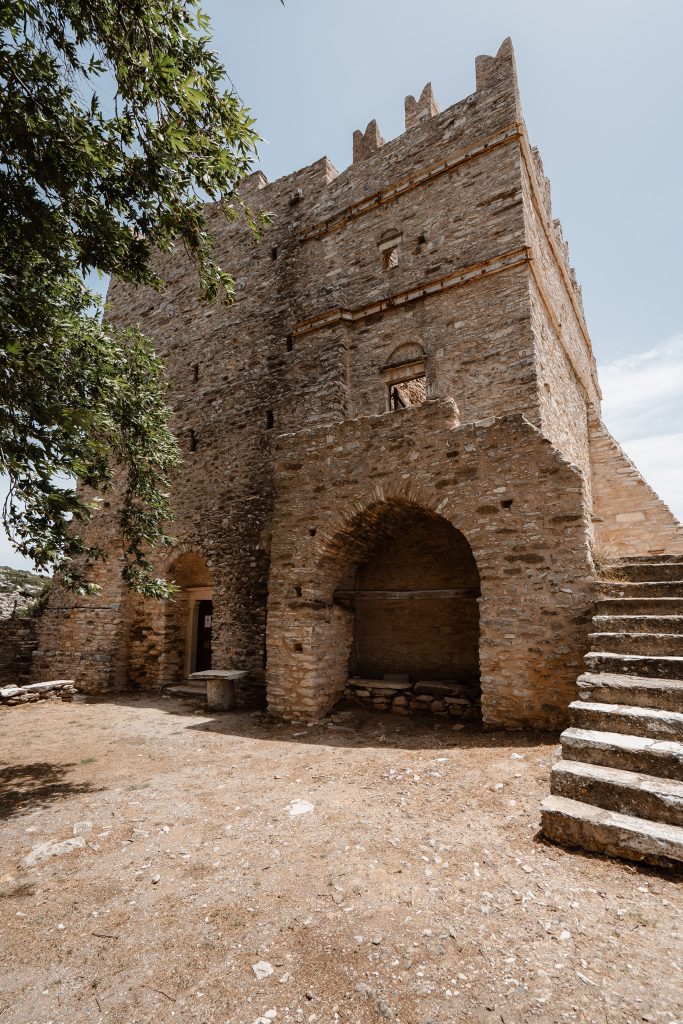
In the afternoon, you drive twenty minutes inland to Apiranthos, a marble-paved hill village that is not performing for visitors. The kafeneion on the main square has three or four tables occupied by men in their seventies playing cards. The woman at the small grocery sells graviera that her family produced two villages over. There are no tour buses. There is not a souvenir shop. You are a visitor, but you are not the point of the village. The community was here before you arrived and will be here after you leave.
In the evening, you eat at a taverna in Filoti where the owner’s table of regulars occupies the corner. They are not performing hospitality. They are having dinner. You are welcome. You are served well. But you are a guest in a place that functions, rather than a customer in an establishment built to serve you.
This is what “Naxos is different” actually feels like. It is not simply that there are fewer tourists , though there are, measurably: Naxos receives a fraction of Santorini’s visitor numbers, which have exceeded a million in peak years. It is that the island has not been restructured around tourism to the same degree. The economy, the agriculture, the village life continue alongside the visitor season rather than being replaced by it. You experience the difference not as emptiness but as coexistence.
What Naxos Is, and Who It Is For
The honest answer to “is Naxos better than Santorini?” is that it depends entirely on what you are after.
If you want visual spectacle , the caldera, the dramatic volcanic landscape, the sunset from a cliff-side terrace , then Santorini delivers that, and nothing Naxos offers will satisfy that desire. If you want nightlife, international dining variety, and a social scene that runs late, Mykonos is the right island. These are not failures of Naxos. They are different travel priorities.
If you want a week where the beach is usable without crowding, where the food comes from the island itself, where you can drive inland and find a functioning mountain village, where your evening ends at a taverna table with fresh seafood and a glass of local wine , then Naxos suits you better. The comparison is not about which island is superior. It is about which island answers the question you are actually asking.
Which island fits your trip?
| What you’re looking for | Best island |
| Dramatic volcanic scenery and a caldera sunset | Santorini |
| Nightlife, international dining, late social scene | Mykonos |
| Long sandy beaches with space to breathe | Naxos |
| Food rooted in what the island actually grows | Naxos |
| Interior villages with functioning local life | Naxos |
| Established wine tourism | Santorini |
| Windsports and a young beach scene | Paros or Naxos |
| Active, self-directed exploration across a full week | Naxos |
The comparison with Paros is closer and harder to call. Paros is similar in scale and character, with a slightly stronger nightlife and a well-established wind-sports scene centered on Golden Beach. The honest difference is that Naxos has longer, softer beaches , Agios Prokopios, Agia Anna, Plaka , and a more substantial interior. Paros has a more developed social infrastructure for younger travelers. The choice between them is genuinely close and depends on whether you prioritize beach quality and exploration or a livelier village scene.
Getting the Most Out of Naxos
Two practical points that change the experience noticeably.
First, Naxos is unusually easy to reach. The airport sits about two kilometers from the Agios Prokopios beach area, with direct flights from Athens and seasonal connections from several European cities. On Santorini or Mykonos, you are often looking at a ferry from Athens plus a transfer from the port to your accommodation. On Naxos, you can land and be at the beach within fifteen minutes of collecting your bag. For a week-long trip, that is a meaningful difference in how the holiday actually begins.
Second, the shoulder season , May, June, and September , is where Naxos’s qualities come through most clearly. The agricultural cycle is active, which means the food is at its best. The sea is warm enough to swim comfortably. The villages are fully functioning, not yet quietened for autumn. And the beach in the morning feels like it belongs to you in a way that even early July cannot quite match. If your dates are flexible, aim for either side of the main summer rush.
Naxos also works well as a hub for island-hopping. The ferry connections from Naxos port are frequent and reliable, with regular services to Paros, Mykonos, Santorini, and the smaller Cycladic islands. That reliability matters more than most travelers realize until they find themselves waiting out a weather delay on an island with two departures a week.
Where to Base Yourself
If the picture this article describes sounds like the kind of week you are looking for, Agios Prokopios is the practical answer for where to stay. It sits 350 meters from one of the longest sandy beaches in the Cyclades, five kilometers from Naxos town for evenings with more variety, and two kilometers from the airport. The village itself has a functioning Greek character , families, a market, local tavernas , that a more developed resort zone would not.
Lagos Mare is based here. The hotel has thirty individually styled rooms, a restaurant called the 1924 that sources fresh fish from the family’s own fishing boat, and a Greek breakfast included with every stay. If you book directly through their website, the Loyalty Club gives you ten percent off from your first reservation, along with a complimentary minibar and a discount at the restaurant. It is a specific, unhurried place , suited to the kind of trip this island is actually for.
Details and availability are on the Lagos Mare.
The island does not compress into a single image. That is not a gap in the marketing. It is the point. You photograph Santorini’s caldera because the caldera is the entire show. You photograph Naxos’s port truck with its sacks of potatoes and its wheels of graviera not because it is beautiful but because it tells you what kind of place this is: somewhere that feeds itself, feeds its visitors, and asks nothing more of you than the curiosity to look past the postcard.
FAQ
Is Naxos better than Santorini?
Not objectively , they serve different needs. Santorini delivers visual spectacle and a highly developed luxury infrastructure that Naxos cannot match. Naxos offers usable beaches, food sourced from the island itself, and interior villages that Santorini’s narrow volcanic geography cannot support. If a dramatic sunset and established wine tourism are your priorities, Santorini is the right choice. If space, local food, and a less stage-managed experience matter more, Naxos will serve you better.
Is Naxos worth visiting?
For the right traveler, genuinely yes. If you want a beach long enough to walk without weaving through crowds, food rooted in what the island produces, and the option to drive twenty minutes inland and find a hill village with no tour groups, Naxos delivers all of that. It is less suited to travelers seeking nightlife, a structured resort environment, or the kind of visual drama that Santorini’s caldera provides.
What is Naxos known for?
The Portara , the massive marble doorway of an unfinished Temple of Apollo overlooking the harbor , is the island’s most recognisable landmark. Beyond that, Naxos is known for its agricultural production, particularly its PDO-certified graviera and feta, its long sandy beaches (Agios Prokopios, Plaka, Agia Anna), its interior mountain villages including Filoti and Apiranthos, and its size. It is the largest of the Cycladic islands and by far the most self-sufficient.
Is Naxos a party island?
No. There are bars and some evening activity in the main town and along the beach road, but there is no club scene, no summer DJ residencies, and no nightlife infrastructure comparable to Mykonos or Ios. Evenings on Naxos center on taverna meals, walks along the seafront, and drinks at a hotel bar or local café. Travelers seeking nightlife should choose a different island , and that honesty is part of what makes Naxos the right choice for the ones who are not.
What type of traveler suits Naxos best?
The independent traveler who enjoys self-directed exploration. Naxos rewards curiosity , the willingness to drive inland, find the taverna the locals actually use, explore beaches beyond the main strip. It suits couples, families with older children, and anyone who finds seven passive days by a resort pool more exhausting than restorative. It is less suited to travelers seeking a fully curated, passive holiday experience.
Is Naxos the largest Cycladic island?
Yes, at approximately 440 square kilometers , larger than Santorini (around 90 km²) and Mykonos (around 105 km²) combined. Its scale is also genuinely distributed: the interior is not a narrow strip behind the coast but a substantial mountainous region with functioning villages, working farmland, and significant archaeological and cultural sites scattered across the hills.