
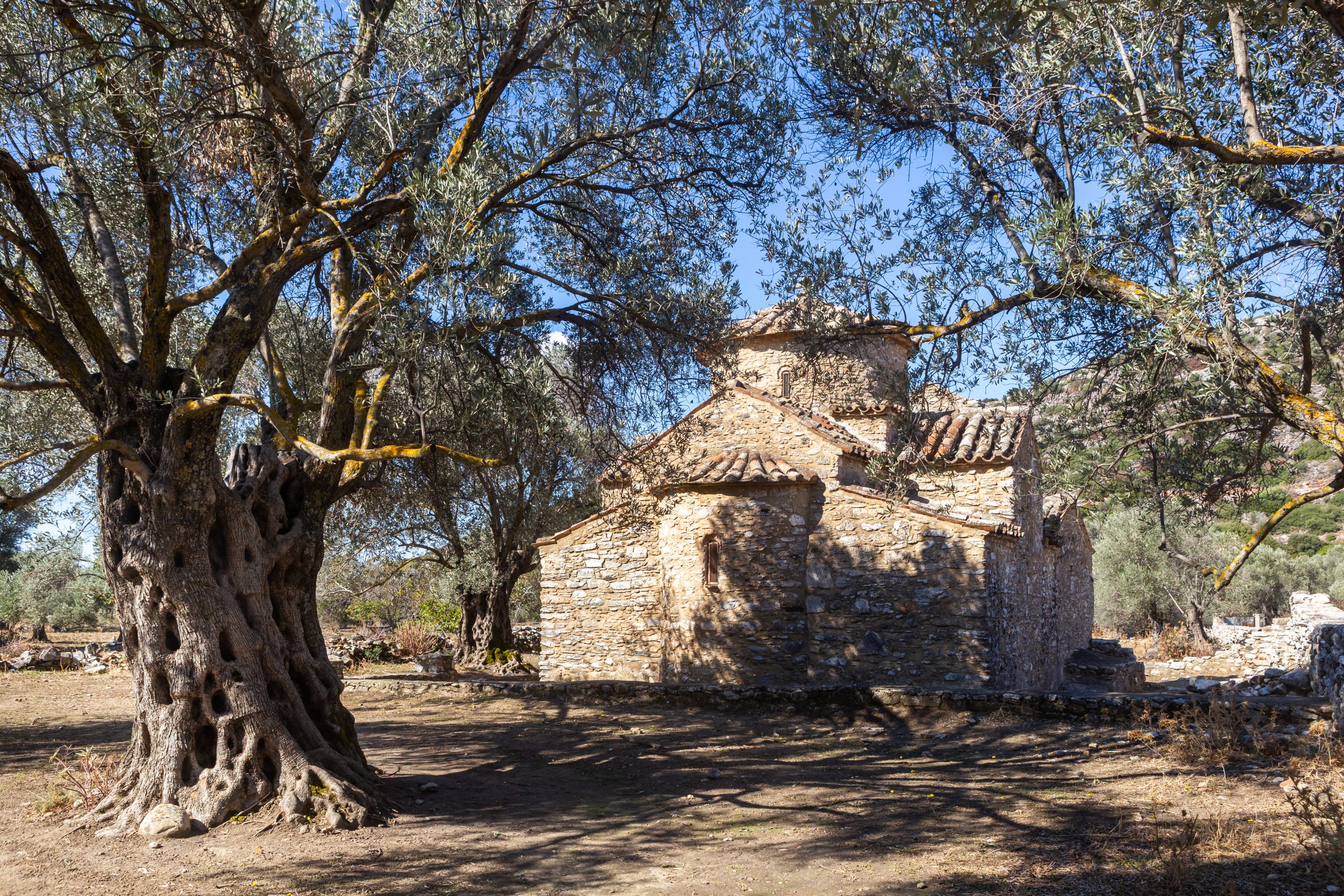
The figure lies half-buried in the olive grove, ten and a half meters of white Naxian marble that once had a face. His left leg is mostly freed from the surrounding stone. His right side remains encased. He has been here since roughly 530 BCE, abandoned mid-carving, surrounded by the same kind of trees his makers would have known. There is no fence. There is no plaque explaining that he is a kouros, an Archaic male figure of a type produced across Greece in the sixth century BCE, because the workers who began him simply left one day, and the grove grew back around what they had started. The only sound is the wind moving through the olive leaves.
This is where Naxos’ history is most legible: not in a museum hall, but lying on its back in the landscape, waiting for someone to walk the dirt path and find it.
Naxos is the largest of the Cyclades, 430 square kilometers of marble and mountain rising from the Aegean. Its highest point, Mount Zas, named for Zeus, who according to local tradition was raised in a cave on its slopes, shows evidence of occupation stretching back to around 7000 BCE. But what makes the island genuinely significant, rather than merely old, is what it produced: marble so fine that it ended up in the Parthenon, a brief but brilliant maritime empire, and a concentration of unfinished sculpture that tells us more about the Archaic Greek world than many completed statues do.
The island’s history is unusually readable for a traveler willing to go a few hundred meters off the main road. You do not need a guidebook to follow the thread if you know what to look for.
The island before Greece was Greece
The Cycladic civilization that flourished between roughly 3200 and 2000 BCE is best known for its marble figurines: the folded-arm female figures with blank faces that now sit in museum cases from Athens to New York. Naxos was a major center of this world. Excavations at the site of Grotta, on the north-western coast of Chora, have revealed settlement layers, obsidian blades, and the kind of carefully shaped marble vessels and tools that suggest an early craft culture organised enough to sustain trade with Crete, the mainland, and islands as distant as Milos.
What is easy to miss when looking at the figurines in the Naxos Archaeological Museum is that the form itself , the smooth marble surface, the cleanly carved geometry , was a direct statement of technical ability. The stone had to come from somewhere, and on Naxos it came from quarries that would remain in use for the next three thousand years. The island was not simply a place where people lived. It was the source of a raw material that shaped the visual culture of the entire Aegean.
The Grotta site itself is not a dramatic ruin. What remains are wall foundations, stone tools, pottery fragments, and the outlines of rooms. But it establishes the baseline: long before the marble quarries made Naxos famous, the island was already a place where people had figured out how to make things that would last.
Marble, ambition, and the Archaic peak
The Archaic period, roughly the eighth through sixth centuries BCE, was Naxos’ moment of dominance. The island’s tyrant Lygdamis, who came to power around 530 BCE, presided over an Ionian maritime empire that controlled trade routes, exported marble and wine, and minted the earliest known Cycladic coins. This thalassocracy was real but brief. By the late sixth century, the Samian tyrant Polycrates had crushed Naxian naval power, and the Persians finished what Polycrates had started. The period of island-led power lasted perhaps seventy years in total.
What remains from that ambition is the Portara.
The massive marble gateway that stands on the islet of Palatia, connected by a causeway to the Chora waterfront, is not a ruined temple. Nearly every travel article calls it one, but it is not. The Portara is the propylon, the entrance gate, to what would have been a Temple of Apollo, construction of which began around 530 BCE and was never completed. The structure measures roughly nine meters by nine meters at its base. The doorway itself is six meters high. The stone blocks, some weighing as much as twenty tonnes, were brought from the Apollonas quarries in the north of the island.
Why it was never finished is a question without a definitive answer, but the timing aligns with two things: the fall of Lygdamis and the approaching Persian Wars. The gateway was left standing, unconnected to any building, and has simply remained. It now faces the sea and the sunset, which is why photographs of the Portara at dusk are among the most recognizable images of any Greek island. But the sunset is a secondary quality. The primary thing the Portara tells us is that Naxos, for a brief window, had the resources, the ambition, and the architectural capacity to build something on the scale of the great Ionian temples, and then lost the political stability to finish it.
The kouros in the olive grove
The Kouros of Flerio lies in an olive grove between the villages of Melanes and Kinidaros. To reach it, you park on the main road and walk along a dirt track for roughly twenty to forty minutes, depending on your pace. The path is unmarked. Maps.me or a similar offline mapping application is advisable, because the mobile signal in the area is unreliable and the local signage is essentially absent except for a single weathered sign at the turn-off point. In summer, go early in the morning. The olive trees provide some shade, but the walk is exposed.
When you arrive, the figure is simply there. Ten and a half metres of marble, weighing roughly fifty tonnes, lying on his back with his left leg already carved free of the surrounding stone. His right side is still attached to the bedrock. If he had been finished, he would have been among the largest freestanding statues of the Archaic world. He was abandoned, presumably when Lygdamis fell from power or when the political situation made completing such a monument impossible.
The absence of interpretation infrastructure is the most honest thing about the site. No ticket booth, no fence, no laminated information panel. These were not failed sculptures in the sense that something went technically wrong. They were works in progress that were never finished, left where they lay when the circumstances that had made them possible changed. A second kouros, known as the Melanes Kouros, lies in an adjacent quarry. A larger one, the Kouros of Apollonas, is visible in the north of the island, on a more accessible site with shorter approach and slightly better signage.
The kouroi are not mysterious. They are standard Archaic Greek sculpture, produced according to the same conventions that created kouroi on Samos, on Delos, and in Attica. What makes Naxos’ examples remarkable is their scale and their unfinished state. You can look at them and see the process: the workers’ marks, the sequence of carving, the point at which they stopped. It is as close as you will come to walking through an Archaic marble workshop that was simply abandoned one afternoon.
Byzantium, icons, and the island’s interior
The inland villages of Naxos, those away from the coastal strip where the hotels and restaurants sit, are where the island’s Byzantine layer survives. There are more than fifty Byzantine churches scattered across the interior, built between the sixth and thirteenth centuries using local marble and brick, often on sites that had been sacred since antiquity.
Panagia Drossiani, in the village of Moni, is the most significant. It dates to the sixth century with later additions through the twelfth, and its frescoes are among the oldest surviving in the Cyclades. The building itself is modest: a small cruciform structure with a dome, constructed from the same marble that built the ancient temples. The frescoes inside, Christ Pantocrator, the Virgin, scenes from the life of the saints, are faded in places but intact enough to be genuinely affecting. The church is usually unlocked and carries no admission fee.
Other churches are harder to find. Protothroni, near the village of Chalki, contains twelfth-century frescoes that are largely unmarked. Agios Mamas, near the monastery of the same name, holds fragments of a much older structure. These are not curated sites. They are active churches, used for services on their named feast days, and finding them requires either local knowledge, a guided tour, or a willingness to navigate by instinct and a rental vehicle.
A scooter or a quad bike is the practical choice for this layer of the island. The bus network, while reliable for the coastal routes, does not serve the interior villages in a way that makes moving between churches feasible.
Venetian Naxos and the Kastro
In 1207, following the Fourth Crusade, the Venetian Marco Sanudo conquered Naxos and established the Duchy of the Archipelago, a feudal state that controlled most of the Cyclades for the next three and a half centuries. The duchy lasted from 1207 until 1566, when the Ottomans took control, and it left a visible mark on the island’s architecture, religion, and social fabric.
The Kastro, the fortified upper town of Chora, is the primary survival. Its walls contain the Torre Sanudo, the duke’s tower; the Catholic cathedral of the Archdiocese of Naxos; and a network of narrow streets lined with Venetian-era houses, many of which are still inhabited. The carved coats of arms embedded in the walls of the old families, the Crispi, the Barozzi, the Sommaripa, are still legible. The Frankish tombs inside the cathedral bear Latin inscriptions alongside Greek ones.
Venetian rule on Naxos was not purely extractive. The duchy created a layered Greco-Venetian culture in which Catholic and Orthodox communities coexisted, sometimes uneasily, within a shared architectural and legal framework. The Kastro is the physical expression of that coexistence. You can walk from the Catholic cathedral to the Orthodox metropolitan church of the Transfiguration in under five minutes.
The Naxos Archaeological Museum is housed in a seventeenth-century Jesuit school building within the Kastro complex. It is small but well-curated. The Cycladic figurines on the upper floor are the best introduction to the island’s prehistoric culture you will find anywhere on the island. The seventh-century BCE sphinx on the ground floor, with its careful carving and slightly unsettling composure, is worth the admission price on its own.
How to move through Naxos’ history in two or three days
A cultural visit to Naxos does not require a car if you are willing to stay within walking distance of Chora, but it requires one if you want to see the sites that give the island its real historical depth.
At a glance: which sites need a vehicle
| Site | Location | Car or scooter needed? | Approx. time from Chora |
| Portara | Chora waterfront | No | 10 min walk |
| Kastro + Museum | Chora | No | In town |
| Flerio Kouros | Melanes valley | Yes | 30 min drive + 20–40 min walk |
| Panagia Drossiani | Moni village | Yes | 45 min drive |
| Demeter Sanctuary | Sangri | Yes | 30 min drive |
| Apollonas Kouros | North coast | Yes, or bus (2x daily) | 1 hr drive |
Day one: Chora. Start at the Archaeological Museum in the morning, when it is quiet. Walk the Kastro in the late afternoon. End at the Portara for sunset. This is the most accessible day of the three and consistently the most rewarding. Everything is on foot.
Day two: The interior. Rent a scooter, a quad, or a car in Chora and head into the hills. The Flerio Kouros first, before the heat builds. Panagia Drossiani in the late morning. The village of Chalki for lunch and a wander. If energy allows, the Demeter sanctuary at Sangri adds another forty-five minutes of driving and is worth it for the views as much as the archaeology.
Day three: The north. The drive to Apollonas takes about an hour from Chora. The kouros there sits on a more accessible site than Flerio, with better signage and a shorter walk. The coastal road along the north-eastern shore is one of the most beautiful stretches of the island. Combine the kouros with a swim at the beach of Apollonas and a late lunch at one of the tavernas in the village.
For anyone without a rental vehicle: the bus to Apollonas runs twice daily and is slow. The Flerio Kouros is not reachable by public transport. These are the practical realities of the island. Plan accordingly.
FAQ
What is Naxos famous for historically?
Naxos is best known historically for its marble quarries, which supplied stone used in some of the most important buildings and sculptures of the ancient Greek world. The island also achieved a brief but significant maritime empire in the Archaic period and produced some of the largest surviving kouros statues in Greece, several of which were abandoned in the quarries and remain visible today.
Why is the Portara in Naxos so important?
The Portara is important because it is a rare surviving example of an unfinished Archaic Greek temple gateway. It would have been the entrance to a Temple of Apollo begun around 530 BCE. The structure was never completed, most likely because the political upheavals that ended the tyranny of Lygdamis removed both the funding and the purpose. It has stood on the islet of Palatia, facing the sea, for over two and a half thousand years.
What are the kouros statues and why are there so many on Naxos?
Kouroi are Archaic Greek male figures, typically used as grave markers or votive offerings at religious sanctuaries. Naxos has a high concentration of unfinished examples because the island was the primary center of marble quarrying and large-scale sculpture production in the Archaic period. When political circumstances shifted and patronage dried up, works in progress were left where they lay.
Did the Venetians rule Naxos?
Yes. The Venetians ruled Naxos from 1207 to 1566 under the Duchy of the Archipelago, established by Marco Sanudo following the Fourth Crusade. The period left a lasting architectural mark in the Kastro of Chora and produced a layered Greco-Venetian culture that is still visible in the island’s religious buildings, inscriptions, and family histories.
What is the best way to visit Naxos’ historical sites without a car?
The Portara, the Kastro, and the Archaeological Museum are all walk-able from Chora. For the Flerio Kouros and the Byzantine churches of the interior, a rental vehicle or organized tour is necessary. The bus to Apollonas runs twice daily but is slow and does not serve the inland sites. A scooter is the most practical option for a self-guided cultural day in the hills.
Naxos carries its history in a way that few islands do. Not as a museum to be walked through, but as a landscape you can still read: the marble in the ground that became the statues and the temples, the quarries where the work stopped, the churches built into older sanctuaries, the Kastro walls that hold a coat of arms from a family that arrived eight hundred years ago. It is an island that accumulated rather than performed its history. You can feel that difference when you stand at the Portara and realize the gateway has been facing the sea, unfinished, for two and a half millennia.
Lagos Mare is in Agios Prokopios, five kilometers from Naxos town and the Kastro. For a culturally oriented stay, it is a practical and quiet base: close enough to reach Chora in ten minutes by car, far enough from the town to make the return feel like arriving somewhere rather than retreating to it.